
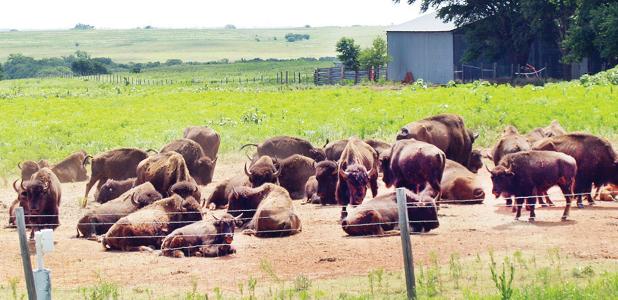
Bison herd from Foss Park getting new home
The bison herd that’s been an attraction at Foss State Park for nearly half a century has been sold and will be moved soon.
But not far. That’s because the approximately 65 animals in the herd now were purchased by the Cheyenne-Arapaho Tribes and will be moved to a tribal pasture just a few miles away next to their Lucky Star Casino on State Highway 33 outside Hammon, but still in Custer County.
“They’ll be in an area where the public can see them, in a pasture right next to the casino,” said former Clintonite Nathan Hart, economic development director for the tribes who consummated the purchase.
Hart submitted the winning bid of $88,002.01 in an online auction that ended at 3 p.m. May 16. He said the tribal governor and lieutenant governor (Reggie Wassana and Gilbert Miles, both of the Weatherford area) told him “to make it a priority to purchase this herd.”
So he did, submitting five total bids, all on the last day of the auction with four of them in the last 45 minutes and three in the final 16 minutes as the price grew rapidly higher.
“The final five minutes was pretty active,” he said. Asked if he knew whom he was bidding against, Hart replied, “They don’t disclose that. I tried to check around, but I don’t know.”
Whoever it was, he said he was pleased with what he and the tribes paid, and he’s pleased the State of Oklahoma got good value for its animals.
Bison care will be nothing new for the C-A tribes. Hart said they have approximately 300 head already, all in 4,000 acres of pastureland near tribal headquarters at Concho outside El Reno.
The Hammon pastures contain 1,200 acres, and another 2,200 tribal acres near Colony currently have no bison on them.
“At Colony and Concho we have excellent grass,” said Hart. “Particularly at Concho. They haven’t had the droughts we’ve had in western Oklahoma.”
Those droughts are why the state is selling its Foss bison.
“We didn’t have enough pasture left to keep the herd healthy,” said Barry Hardaway, manager of Foss State Park. “Hopefully we’ll start over (with new animals) in a couple of years. We’re hoping to.”
Hardaway said the 65 bison sold in the auction included 10 calves born in the last 45 days. He wasn’t sure how many of the cows sold are now pregnant.
Hart said those purchased by the tribes include 20 to 22 cows of calf-bearing age plus probably five big bulls. “The rest are yearlings,” he said.
Female bison begin producing calves when they’re about three years old, he added.
Funds to pay for the Foss herd are primarily gaming revenues brought in by the casinos at Concho, Clinton and Hammon.
“It’s money out of the economic development budget,” said Hart. “That’s the program I run.”
Hardaway said the herd sold in the auction was started around 1971. “We wanted to show the public native creatures that roamed the prairie,” he said.
All those sold in the auction were healthy animals, he asserted, adding that many of the bidders were private individuals from Texas, Kansas, South Dakota and Oklahoma.
“This pasture (at Foss) was beaten down by the drought that started in 2010,” he said. “It came back some, but this year it got beat down again. No early rains hurt us. We felt the best thing for the animals was to find a better place where they can actually have grass.”
Besides grass, he said the bison are fed hay and protein cakes.
Asked the difference between bison and buffalo, with which they’re often confused, Hardaway said: “We don’t have any buffalo in the United States. Historically they’ve been called buffalo, so we stuck with calling ’em buffalo, but they’re actually American bison. Even the big herds that roamed the U.S. for hundreds of years were bison. They weren’t buffalo, but that’s what our pioneers called ’em.”
For further information he deferred to Encyclopedia Britannica. It agreed, stating that buffalo do not roam the American West but instead are indigenous to South Asia (where they’re known as water buffalo) and Africa (cape buffalo).
Then there are the three H’s, the first standing for home, which was just explained; the next humps, which buffalo don’t have but bison do at their shoulders, allowing them to use their heads as snow plows in the winter; and the third is horns, the buffalo’s reaching more than six feet, versus those of the bison which are much shorter and sharper.
The bison of course are culturally more akin to American Indians, who counted on them for food, clothing and shelter long before the white man came to this part of the world. And Hart said that’s one reason the Cheyenne-Arapaho are trying so hard to protect them.
“We were looking to grow our herd,” he said. “I had it in my budget to buy more this fall, but when we found this herd was for sale, we decided to go ahead now. We wanted the state to get fairly close to what their market value is supposed to be, and we wanted them to stay in Oklahoma.
“We were looking to expand our herd this year, and we felt this was a good opportunity to pick up a whole herd. We’re very connected culturally with the bison, and that’s the primary reason we were looking to expand our herd.”
Hart said the herd will be moved to its new quarters by truck next Monday, maybe between 10 and 11 a.m.