
Corporation Commissioner Visits Clinton
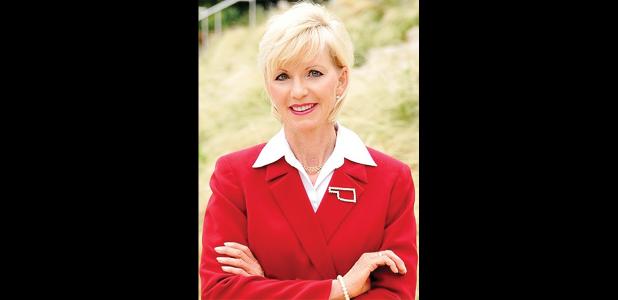
After nine years on the Oklahoma Corporation Commission helping solve state problems ranging from earthquakes to electricity generation, Dana Murphy says she’s ready for new challenges.
And she’s hoping to find them as the state’s next lieutenant governor.
Commissioner Murphy brought her fledgling campaign for the state’s No. 2 political position to western Oklahoma this week, and to Clinton in particular. She stopped for an interview with the Clinton Daily News en route to a Tuesday night trip to Elk City where she spoke to a gathering of Beckham County Republicans.
The Woodward native who now lives in Edmond said she’s faced great challenges in her personal life as well as her state role the last few years.
Personally, she said she’s had to transition between rural and urban Oklahoma all her life. But she had three brothers until two years ago when the one running their family’s red Angus ranch in Ellis County died unexpectedly. Since then her two surviving brothers and her mother have experienced six heart attacks among them.
“We’ve had to learn to work together in different ways to keep things going,” she said.
In the same way, she said state leaders need to work together to solve the problems that keep coming back every year to challenge them.
She identified business recruitment as a major goal if she’s elected lieutenant governor next year.
“What are companies looking at?” she asked, then answered the question herself. “How the legislature deals with budgets, how the education system works, roads and infrastructure.”
Commissioner Murphy insisted she already has a proven record as a problem solver.
“Oklahoma is among the six or seven states with the lowest electrical prices in the nation,” she said. “That’s a great advantage we can use,” especially with high-technology companies that are dotting the industrial landscape now.
Electricity of course is one of the many industries the Corporation Commission regulates.
But in recruiting newcomers, Murphy said she would not overlook firms already in Oklahoma. “We have to give companies that have stayed the course help too,” she said.
“Aerospace is looking for STEM students,” she added, clicking off science, technology, engineering and math as key among the fields Oklahoma needs to focus on if it’s going to improve its educational standing among the states.
That brought on a discussion of this state’s seismic activity, which peaked in 2014 with a five-fold increase from the year before to 585 earthquakes of magnitude 3.0 or greater. That put it suddenly No. 1 among the nation’s 51 states.
Since then, though, the number has lessened as restrictions ordered by Murphy’s Corporation Commission on deep disposal of wastewater from oil and gas wells apparently took effect. She said the last three years the daily numbers of quakes measuring 2.7 or greater dropped in 2015 to 5.3, in 2016 to 3.5, and so far in 2017 to 1.8. And of course it’s going to take a quake of 5.5 or so to do much damage.
Murphy said it was collaboration among industry, researchers and regulators like the Corporation Commission she now chairs that made the difference.
Concerning the wastewater being pumped into the ground which she believes is a major instigator of the quakes, she said a few folks wanted to shut in every well in the state while others would have let anything go. “We had to follow science and follow the law,” she said.
She came to Clinton armed with charts depicting the drop in drilling the last few years as prices fell even before oil from Iran was allowed back on world markets by President Barack Obama and his secretary of state, Hillary Clinton. One of her charts showed intents to drill in Oklahoma topping in 1980 at more than 22,500, then falling significantly below 2,500 in 2015. That was the last year shown on the chart.
In the last decade, 2008 was the benchmark year with more than 6,000 drilling permits approved.
“Intents to drill are really the indicator of what activity is going to be,” said Murphy.
Equally significant for this area is that a majority of the permits have been in the STACK and SCOOP fields. Blaine County is the heart of the STACK which also includes major portions of Kingfisher and Canadian counties to the east. Back to the west in this area, it includes almost the eastern half of Dewey County and a chunk of Custer County centered around Thomas.
STACK is an acronym for Sooner Trend Anadarko Canadian and Kingfisher while SCOOP is the South Central Oklahoma Oil Province. It’s in central Oklahoma and encompasses much of Grady, Stephens, McClain and Garvin counties, all south of Oklahoma City.
Originally oil and gas wells were drilled straight down, making them vertical, but the last decade or so laterals branching off under other sections of land have become popular. Those wells are called horizontal, and about 80 percent of the ones being drilled now are that type.
Ms. Murphy was asked if horizontal wells are fair to nearby royalty owners.
“Oklahoma is a Law of Capture state,” she said. “What you capture at the surface is what you own. We have to continue to evaluate them.”
She said it’s interesting how expensive horizontal wells are to drill but they can still be made to work even at today’s comparatively low prices for the finished product.
“Very few vertical wells are being drilled now,” she added. “With these prices it’s hard to make ’em work.”
And she doesn’t see anything on the near horizon that’s going to make oil and gas prices rise.
Asked about wind power and whether the splurge in wind towers might be over, she said she sees all energy sources continuing to do well.