
Internet services cost WPLS $300,000+ a year
Telephone bills are notorious for the long list of small fees tacked on to the end of them, most of which make no sense to the average reader. But Western Plains Library System Executive Director Tim Miller said he can explain at least one of those fees because it happens to be one that enables WPLS to provide free Internet service in all its libraries.
The contract for providing that Internet service — worth hundreds of thousands of dollars to Clinton and surrounding areas — is up for renewal this year and the bidding process has begun.
“If you get out your cell phone bill or your land line bill, at the very end of it is all those fees and charges. One of them is called the Universal Service Fund,” Miller said. “That’s a fee that goes into a gigantic national pot, and then schools, libraries and rural health care, all three, apply to that to subsidize the cost of their Internet and telecommunications. And the program that governs all that is called E-Rate.”
He said the program is in its 19th year now. WPLS has been in it since the beginning, and currently qualifies to have 90 percent of the cost of its network subsidized. Other E-Rate users in this area are Clinton schools, rural hospitals, and Western Technology Center.
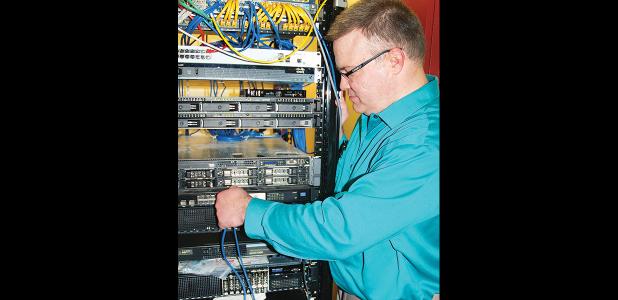
“Our current WAN (wide-area-network) contract that’s expiring, which was funded through E-Rate, is a little over $300,000 a year. It’s the most expensive piece of technology we have. The way it works is, all eight of our branches have a network link back to our headquarters on Modelle, where our servers filter the Internet for pornography and various other things.”
WPLS’s current contract was approved by E-Rate four years ago,which at the time used the only viable technology available to get the Internet speeds the library system required. But the technology landscape has changed considerably since then, Miller said.
“When our current contract goes away, we’re going to get new numbers and potentially a new vendor. Technology has considerably improved in the last four years, and it’s gotten cheaper.
“Since we last opened a bid for the WAN, local (telecommunication) companies have invested in their infrastructure and run fiber (optics) into towns where our branches are. So I’m expecting local vendors that didn’t bid before to bid this time.”
Miller described E-Rate as a very complicated federal program that’s “a lot like filing your taxes.” And because of the enormous size of the project — both financially and geographically — the bid solicitation is opened to vendors nationwide.
“The tricky thing is that there are multiple types of technology out there that could provide us with WAN, and we don’t get to dictate which one we want,” he said. “We have to take any and all bidders, and E-Rate gives the final approval.”
But to prevent having their time wasted by frivolous bids submitted by unqualified vendors, WPLS is allowed to weed those out by requiring interested parties to attend a meeting in Clinton. Companies who don’t invest the time and effort into sending a representative are automatically disqualified.
The bidding window ends Jan. 9, 2019, and the awarded bidder must commence work by July 1, 2019. Because of the highly specialized nature of the work, Miller said he’s expecting at least three, but probably not more than five, bidders.
“Everybody has a phone these days and we’re all paying into this big national fee, so people ought to know how it’s being spent. We can at least show you how that one small contribution on your bill gets spent,” he said.
“E-Rate’s a wonderful program. Most people look at those fees on the back of their bill and wonder what they do. Well, this is one that I think is actually pretty good.”